Tuesday, February 4, 2025

 February 4th, 2025 

Ground Ops - Small Russian gains near Kupyansk, Chasiv Yar, Toretsk, Pokrovsk

- More soldiers shifted to Infantry 


Politics  - More on possible talks


Weather


Temperatures below freezing all over Ukraine, wind chills in the teens; terrain freezing, improving mobility, clouds remain, continuing to degrade reconnaissance operations.


Kharkiv

33 and cloudy. Cloudy all week, daily lows in the 20s but dropping, into the teens by Friday; windchills colder - teens at first, single digits by weekend. Winds variable, 5-10kts.


Melitopol

33 and snowing. Mostly cloudy all week; more snow on Thursday. Daily lows in the 20s into Monday, daily highs in the low 30s early in the week, by the end of the week highs will be in the upper 20s. Windchills in the lower 20s to teens. Winds variable, 5-10kts.


Kyiv

30 in light snow, gusting to 20. Cloudy through the week; temperature highs and lows will be in the 20s all week, wind chills in the teens. Winds variable, 10kts.


Ground Operations 


Kursk Salient


Fighting continues along much of the perimeter of the salient but there were no confirmed charges in the front line.


North of Kharkiv


Fighting was reported in Vovchansk and near Hlyboke but there were no confirmed charges to the front line.


North of the Donets River


Russian forces appear to have advanced on the west side of the Oskil River near the Ukraine - Russian border, as well as north of Kupyansk - pushing into Zapadne, and also making small gains east of Kupyansk. Russian forces north of Kupyansk are, per the Ukrainian General Staff (UGS), currently regrouping and bringing in fresh troops.

Well south of Kupyansk Russian forces south of Kopanky (due east of Borova) appear to have gained more ground as they push westward towards Borova.

In addition, Russian forces west of Terny appear to have extended  their position both to the west and the north.


Bakhmut


Fighting continues north and north-east of Bakhmut but there were no confirmed changes in the front lines.

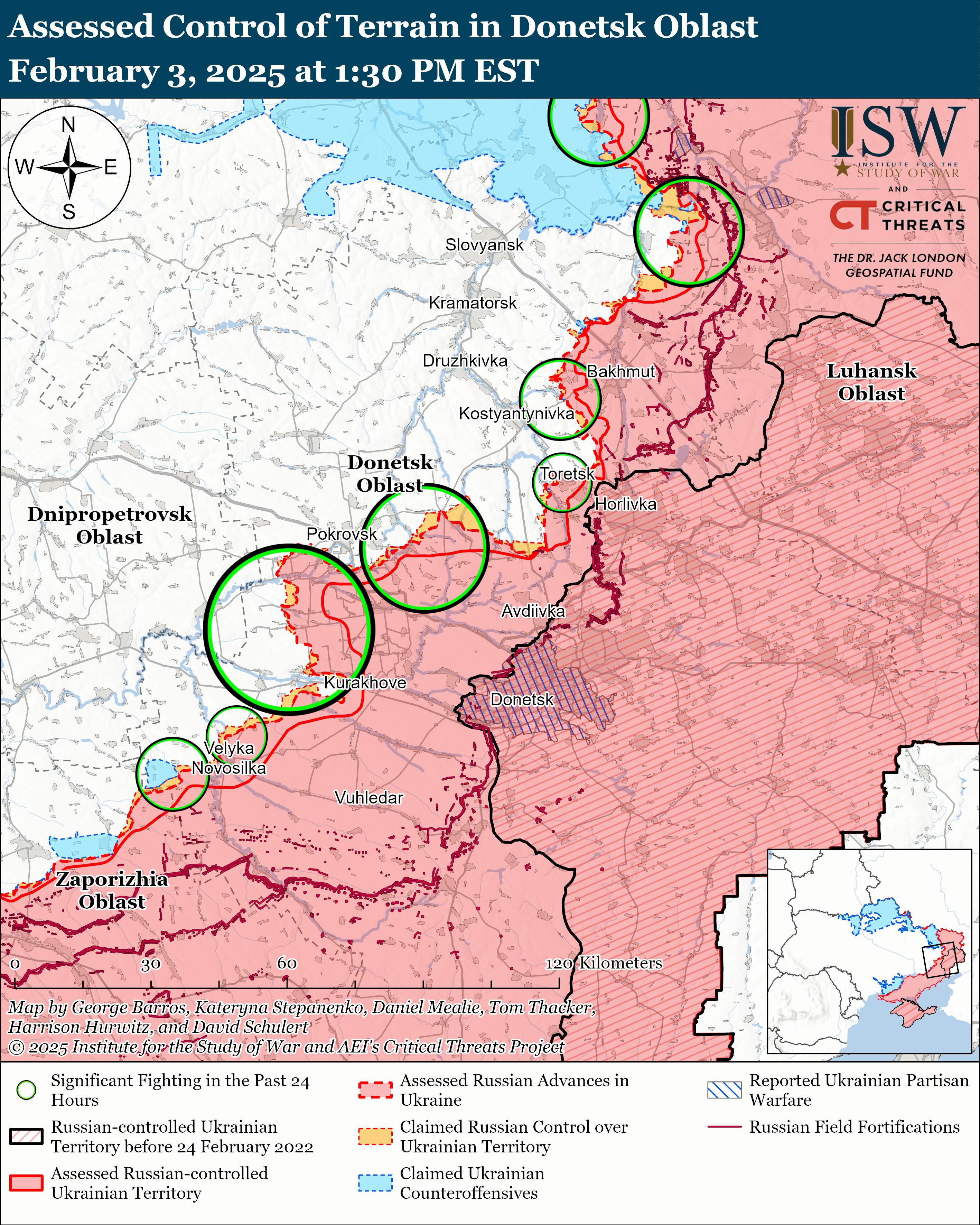
Russian forces made gains in Chasiv Yar, pushing further into central and western Chasiv Yar. South of Chasiv Yar Russian forces have pushed west and have reached the terrain just south-east of Bila Hora.

Further south Russian forces are pushing north out of Toretsk and further into Krymske, and to the south-west further into Shcherbynivka. Further south Russian forces are pushing west and straightening and extending the Russian line further to the west.


Donetsk City


Russian forces continued to attack along most of the perimeter of Pokrovsk salient and posted small gains along much of that perimeter, with gains both north-west and north-east of Vozdvyzhenka, west of Pokrovsk, and west of Kurakhove.

As for the pocket south-west of Kurakhove, Russian forces remain on the attack but there was no confirmed change in the extent of the pocket. However, it appears that Russian forces gained ground in Andriivka, astride the exit to the pocket, which increases pressure on the Ukrainian forces to withdraw.

Further south, Russian forces remain active west and north-west of Velyka Novosilke, but there were no changes to the front lines.


Southern Ukraine


Fighting was reported across southern Ukraine and along the Dnepr River, and Russian forces appeared to make some gains on Big Potemkin Island at the mouth of the Dnepr.


Air Operations


Russian forces launched 71 x Shahed strike drones into Ukrainian air space on the night of the 2nd. The UAF claimed it shot down 38 drones, and 25 drones were “lost” (defeated by EW). Damage was reported in Cherkasy, Kharkiv and Sumy oblasts.

Ukrainian forces conducted another drone strike on Russian oil infrastructure, hitting the Lukoil's Volgograd Oil Refinery in Volgograd City and the Astrakhan Gas Processing Plant near Astrakhan City. Fires continue to burn but there are no definitive assessments yet as to the overall extent of the damage.


Politics


The Ukrainian General Staff has ordered that 50,000 soldiers be stripped out of various non-infantry units, transferred into infantry units, and sent forward to plus up under-manned units. There is additional reporting - rumors - that transfers to infantry units are now being used as punishment for various infractions such as drunkenness and fighting.


The count has been completed and President Lukashenko of Belarus was re-elected on January 26th with 86.82% of the 5.9 million total votes, or 5.1 million votes; this will be his 7th term in office. Lukashenko has been president of Belarus since 1994.


Poll Results;

67% of German support providing military aid to Ukraine, 27% are in favor of reducing aid.

In Poland, 49% favor providing military support to Ukraine - down from 54% last year, those opposed now at 35%, up from 26%

In the Czech Republic 60% are NOT in favor of aid to Ukraine.


Hungarian Prime Minister Orbán commented yesterday that negotiations between Kyiv and Moscow should begin as soon as possible, to prevent Ukraine from suffering the same fate as Afghanistan.


The Trump Administration has lifted the suspension of aid to Ukraine; the suspension was in place for 1 week before being lifted.


Economic Reporting


Feb22   Mar 7   Jun10-22 Jun8-23 Jun7 Sep9 Dec9 Jan8 Feb3 Feb4

Brent      94.71      119.50 120.90    75.58      80.06 71.74 72.63 76.69 75.46 76.22

WTI     92.10      123.80 119.50  71.29      75.81 68.37 68.85 73.94 72.46 72.73

NG       3.97       4.45     8.41      2.15      2.82 2.20 3.17 3.66 3.32 3.30


Wheat     8.52       12.94    10.71    6.17       6.40 5.67 5.59 5.37 5.68 5..75

Ruble     85         145.70  58.48     82.59      88.77 90.75 100.84 105.18 99.76 100.59

Hryvnia Pre Oct 2023 fixed at 36.4 40.89 41.55 42.33 41.70 41.70

Urals 56.56    67.61 78.83 66.19 71.76 70.12 68.51

ESPO 65 77 78.19 76.96 78.46

Sokol 66.23 65.32 72.79 71.79 70.79


Thoughts


Two separate reporting strings that weigh on the war’s end game:

A report on Russian casualties during the past 12 months, produced by the Ukrainian Ministry of Defense. The UKRMOD claims that during the month of January 2025 Russian forces suffered 48,240 casualties.

Assuming an average spread of 1 KIA for 3.5 WIA, this would break to something on the order of 10,500 KIA and 38,000 WIA for the month of January. This is on top of a claim of some 420,000 total casualties for 2024, which would break to something like 90,000 KIA and 330,000 WIA - for 2024.

Given the tactics used by the Russians for the last 2 years, these number seem to be inconceivable.

Two numbers speak against the veracity of these numbers. The first is the MediaZone daily tracking in detail of Russian casualties as reported in Russian local news outlets and through thousands and thousands of social media sites. This effort produces a total Russian KIA count on the order of 91,000 as of the end of January, which would suggests 320,000 WIA.

At the same time there is a figure - released by the Ukrainian General Staff - that Russia will need to recruit 280,000 personnel in 2025 to replace those whose enlistment is up as well as replacing casualties. This would suggest a far lower casualty rate, and certainly not one that saw 400,000+ casualties in one year. In fact, a rough, back-of-the-envelope number would suggest less than 100,000 total casualties for the year, for the Russian army.

Meanwhile, the Ukrainian army, which holds all casualty numbers as state secrets, with a reported 880,000 personnel currently in the army, is transferring some 50,000 soldiers of various disciplines into the infantry to plus up units that are undermanned due to high casualties; this is in addition to 5,000 Ukrainian Air Force personnel who were recently turned into infantry soldiers.

Reportedly these 50,000 will equate to 20% of all forward forces. Whether that means that there are 250,000 troops forward and 50,000 are being rotated out, or 200,000 and these will simply fill empty slots, or some combination of the above, isn’t clear.

What it does suggest is that Ukrainian forces continue to take significant casualties, and that manpower and replacement of troops is becoming increasingly problematic.

v/r pete 


Monday, February 3, 2025

 February 3rd, 2025 

Ground Ops - Russian gains near the Oskil, Chasiv Yar, 

- Small Ukrainian gains in Toretsk

- More Russian gains around Pokrovsk


Politics  - Talks and rumors of talks - Everyone getting on board?


Weather


Temperatures are moving back below freezing all over Ukraine, wind chills in the teens; terrain should be freezing up, improving mobility, but clouds remain, continuing to degrade reconnaissance operations.


Kharkiv

33 and cloudy. Cloudy all week, daily lows in the 20s but dropping, into the teens by Friday; windchills colder - teens at first, single digits by weekend. Winds variable, 5-10kts.


Melitopol

33 and snowing. Mostly cloudy all week; more snow on Thursday. Daily lows in the 20s into Monday, daily highs in the low 30s early in the week, by the end of the week highs will be in the upper 20s. Windchills in the lower 20s to teens. Winds variable, 5-10kts.


Kyiv

30 in light snow, gusting to 20. Cloudy through the week; temperature highs and lows will be in the 20s all week, wind chills in the teens. Winds variable, 10kts.


Ground Operations 


Kursk Salient


Engagements were reported around the entire perimeter of the salient over the course of the weekend, but there are no confirmed changes in the front lines. Anecdotal reporting from various blogs move the lines in or out on both sides of the salient, but which reports are most accurate is impossible to tell. Unconfirmed reports do, however, suggest that the salient now ends just a mile north of Malaya Loknya, and that the Ukrainian General Staff (UGS) depiction of the front line extending 3 or 4 miles north of that town is incorrect.


North of Kharkiv


Fighting was reported in both small salients north of Kharkiv, but there were no changes in the front line.


North of the Donets River


North of Kupyansk fighting continues as Russian forces continue to try to push west and north-west from the Dvorichna area but they do not appear to have made any gains and Ukrainian forces appear to be holding immediately east of Kutkivka, as well as around Zapadne. There was also reporting on the 1st that Russian forces were active near Topoli, the Ukrainian town on the border with Russia, on the north side of the Oskil river, where it enters Ukraine from Russia. There are no further details in that report.

South of Kupyansk Russian forces managed to gain ground as they pushed westward towards Borova; Russian forces pressing south-westerly out of the Zelenyi Hai area are now less than 7 miles from Borova. Terrain between Zeleny Hai and Borova is mostly manicured farmland with one small creek flowing towards the Oskil, to the north of the line from Zeleny Hai to Borova.  Zeleny Hai is about 460 feet above sea level, Borova is about 400 feet, and the highest point between them is about 490 feet, so fairly gentle terrain (reminiscent of eastern Pennsylvania farmland).

More fighting was reported along the south end of the line of contact in this area, but there were no confirmed changes in the front lines, although some reporting suggests some Russian gains west of Terny.


Bakhmut


The UGS is reporting Russian gains north-east of Siversk, just west of Bilohorivka around the town of Hryorivka, along the southern bank of the Donets River, but reports are not clear and it may also reflect Russian gains north of the river in the Serebrianske forest.

Russian forces had small gains just north of, and in Chasiv Yar, confirmed by the UGS, with Russian forces pushing further into the Shevchenko section of Chasiv Yar.

Further south, in and around Toretsk, Ukrainian forces made small gains just west of Torestk on the south side of Shcherbynivka over the weekend. Russian forces continue to squeeze Krymske and Dachne, just north of Toretsk.


Donetsk City


Fighting continues along most of the perimeter of the Pokrovsk salient. 

Of note, east of Pokrovsk Russian force continue to push north in the general Vozdvyzhenka area. Meanwhile, west of Pokrovsk Russian forces pushed northward from Kotlyne along the rail line and are approaching the junction between the two major rail lines that enter Pokrovsk, one from the south-west - that they are using, and one from the north-west, now less than 3,000 yards away.

Just to the west Russian forces have reached Udachne and Novoyelyavetivka, and further south appear to have pushed into Andriivka, west of Kurakhove.

Fighting continues along the perimeter of the pocket south-west of Kurakhove but there has been no confirmed change in the boundaries of the pocket for several days.

The UGS reports that Russian forces have pushed into Novosilka, about 6 miles west of Velyka Novosilke, as of Sunday.


Southern Ukraine 


Fighting continued in the Orikhiv area and along the Dneper, with multiple probes and artillery exchanges, but there were no confirmed changes to the front line.


Air Operations


On the night of the Russian forces launched 123 x Shahed drones and 42 missiles of various types into Ukrainian airspace. The breakdown of missiles was:

7 x Iskander-M/KN-23 ballistic missiles

7 x Iskander-K cruise missiles

8 x Kh-22/32 cruise missiles

4 x Kalibr cruise missiles

8 x Kh-101/Kh-55cm cruise missiles

10 x Kh-59/Kh-69 cruise missiles 

2 x Kh-31P guided aerial missiles

123 x Shahed drones

The UAF claimed it shot down 56 drones and 61 drones were lost (defeated by EW).

There has been no breakdown yet of which missiles were shot down, but there were multiple hits on infrastructure reported across the country.


President Zelenskyy mentioned, during his evening broadcast, that Russian forces dropped 760 glide bombs and launched 660 strike drones and 50 missiles from the 24th of January through February 2nd. 


Politics


President Trump is making waves and the agenda is steadily shifting in his direction. Some developments include:


President Zelenskyy met with Special Envoy Kellogg who reported that:

"Ukrainian President Volodymyr Zelenskyy has already said that he will soften his position on the ground. And Putin will also have to soften his positions… We’re going to have discussions with everybody over time and probably in the near term…And it’s good for both sides."

President Zelenskyy later commented that: “Ukraine is closer to peace than ever during he last three years of war.”


Trump later commented:

”We're dealing with Ukraine and Russia. We have meetings and talks scheduled with various parties, including Ukraine and Russia. And I think those discussions are actually going pretty well."


Polish President Duda, while affirming continued support for Ukraine, commented in an interview over the weekend that Polish troops are not part of the solution.

"We are going to help Ukraine also in the future because it is necessary. We do not necessarily have to deploy our troops there.”

He expressed a willingness to participate in peace negotiations: ”it would be in the interest of Ukraine to have Poland also there,” and noted: ”If we look at that reborn Russian imperialism, in this particular case, Polish and Ukrainian interests are convergent.”


Economic Reporting


Feb22   Mar 7   Jun10-22 Jun8-23 Jun7 Sep9 Dec9 Jan8 Jan31 Feb3

Brent      94.71      119.50 120.90    75.58      80.06 71.74 72.63 76.69 76.86 75.46

WTI     92.10      123.80 119.50  71.29      75.81 68.37 68.85 73.94 72.83 72.46

NG       3.97       4.45     8.41      2.15      2.82 2.20 3.17 3.66 3.04 3.32


Wheat     8.52       12.94    10.71    6.17       6.40 5.67 5.59 5.37 5.61 5.68

Ruble     85         145.70  58.48     82.59      88.77 90.75 100.84 105.18 98.62 99.76

Hryvnia Pre Oct 2023 fixed at 36.4 40.89 41.55 42.33 41.68 41.70

Urals 56.56    67.61 78.83 66.19 71.76 70.40 70.12

ESPO 65 77 78.19 78.36 76.96

Sokol 66.23 65.32 72.79 72.81 71.79


Thoughts


Trump’s pressure on the system has shifted the “conversation” significantly and both sides appear to recognize that there must be talks, and very soon.

A great deal has been made of statements by various Russians, in particular Putin, Foreign Minister Lavrov, and Deputy of the National Security Council Medvedev that the Russians are only interested in maximal conditions, that is, the de facto surrender of Ukraine.

On the other hand, it seems Putin was simply staking out a maximal positions from which to begin negotiations, as was Zelenskyy. For Trump, it would seem that the key is simply to get both sides talking and from there, segue into a ceasefire. Once the ceasefire is in place, a whole host of options became possible. 

But first, Trump has to have a talk with Putin, which presumably will be an interesting combination of smooth talking and veiled threats; there are rumors that a brief talk may already have taken place. Once that takes place, the real negotiations will begin. As for the EU, they will want to sit at the head table, but in the end they are going to go along with the US.


v/r pete  


Sunday, February 2, 2025

 Mona Lisa Vito and Ship Repair


To say the Navy has a problem with maintenance (or ship construction) is a bit of an understatement.

One has to look hard to find a ship in the last 30 years that has made it in and out  of the yard on time or in budget. Never mind both.

Some ships have suffered through truly incredible delays. USS Boise, a Los Angeles class submarine, perhaps the most extreme example, sat pier side for more than 7 years and had no work done on her. There are maintenance and repair backlogs in virtually every shipyard the US Navy uses.

Meanwhile, the Navy is buying less than a dozen ships per year and yet can’t keep up on maintenance. Our major competitor and de facto enemy, China, has 13 shipyards, one of which - Jiangnan - produces as many ships per years as the 7 major US ship yards combined.

Nor is new construction going well. Without discussing the ongoing nightmare that is the Ford class carrier, consider what is said to be the best ship procurement program the US Navy has had in a generation: the Virginia class submarine. No one will dispute that it’s a very capable submarine. The first submarine was delivered in 2004 and the Navy was scheduled to take delivery of 2 submarines per year. But that has been rolled back to 3 subs every two years, and overall the program is now estimated to be $17 billion over budget, and overall the program is 2 years behind schedule - at least.

In response to all this, the Navy just  rolled out a new, 5-part plan which will:

  • Accelerate force generation to deliver ships and combat systems.
  • Generate readiness to maintain, modernize and sustain platforms.
  • Generate, capture and use data to drive innovation.
  • Strengthen the Navy team by attracting, retaining and growing the NAVSEA workforce.
  • Strengthen the foundation, enhancing NAVSEA critical infrastructure.

The Navy’s plan - put together by, and to be executed by, the same people who got the navy into this mess - really distills down to: we’re gonna be faster and better.

Consider the remark attributed to Albert Einstein, the definition of insanity is doing the same thing again and again and expecting different answers.

And this “solution” doesn't even begin to address the whole problem. The problem with maintenance of Navy ships isn’t a problem in isolation. Rather, as mentioned above, it’s interwoven with ship construction delays, the declining shipyard work force, the overall shipyard capacity, the growing crew scarcity problem, etc., etc., etc. And in fact, you can’t really solve - long term - the ship construction and shipping maintenance shortfalls without addressing the US merchant marine or US port capacity and port throughput and a host of other factors.

This is truly a multi-faceted problem and has to be addressed as such. NAVSEA will not attempt to address a large slice of this - they will focus on what they know and what they do, and the Navy - even if successful in the short term, will head off in one direction; whether that direction dovetails with the solutions to the other facets of the problem will be purely coincidental. 

We need to remember that US shipbuilding and the maritime industry as a whole has problems that reach as far back as the US Civil War. The recovery during WWI and again during WWII are aberrations paid for by huge government spending in both cases and in both cases were followed by fairly steady “glide-slopes” down. So, “fixing” shipbuilding will not be the same as simply having the Navy order a bunch of ships. That is a necessary but not sufficient step. Fixing shipbuilding and shipyard capacity and hence maintenance involves the banks and insurance companies and shipping companies and unions and port authorities, etc., etc.,  etc.

Our national security requires an integrated solution that addresses the entire problem, short and long term. In the solution mentioned above, the folks at NavSea, for example, know their slice of the problem. You might say they are like the tire expert called in to testify in "My Cousin Vinny.” He sees the world from that narrow perspective. The people at NavSea will see the problem from their narrow perspective. But what is needed is, if you will, general maritime knowledge, someone who knows a little bit about each part of the problem, and at the same time has the authority to call in a whole host of experts from across the spectrum, to work out the right mix of solutions.

What we need to do is rid ourselves of the idea that we can fix any one piece of it without affecting everything else: the number of shipyards,  total capacity of shipyard, the number of skilled shipwrights, the number of skilled welders for HY-80 and Hy-100 steel, overall US shipyard capacity (naval and merchant shipping), merchant marine crewing, merchant marine insurance, union influence, Congressional interests, defense contractor acquiescence, union issues, port infrastructure, etc.

The SecNav should designate someone - and give him the necessary authorities to assemble key individuals from each sector and task them to come up with a plan that would address at least the items below (Note: the “We” here is all of us: the USA, we are a maritime nation and this is a national problem):

1) The short term fix to ship maintenance and repair - how do we catch up on already due maintenance and repair and clear out the backlog?

2)  How do we address the need for workers and technicians? We need “trade schools” centered on the yards but there is no reason we couldn’t work some deal with state universities to establish purpose focused community colleges that, like going to a service academy, are paid for by the US, but incur a pay-back period at a ship yard, while also giving graduates credit at 4-year universities.

3A) US Shipping - short term - can we offer green cards to Philippine and Panamanian crewmen to come and work on US ships? Can unions and Congress work to adjust the the law so that folks can spend more of the year at sea if they wish? Unions need to be brought aboard. Also, can we develop a Merchant Marine Reserve, and increase the number of crewmen who are “current?”

3B) US Shipping - how do we provide incentives for more automation and reduced manning, while maintaining safety and performance? How do we get the unions on board with this? How can we attract foreign shippers to use US ships? What exactly would be necessary to drive the costs down to competitive levels? Banks and Unions and Insurance companies key here.

4A) Ship Construction short term - Can we allow some US ships to be built overseas - Korea, Japan, Norway. If there are certain security issues, can we have hulls built overseas and the ships fitted out in the US?

4B) Ship construction long term - Can we develop a funding (banks and corporations) for an increased and sustained production effort? Work with insurance companies to clean up the ocean of old ships. (This is worse than it looks - unless specially built (aircraft carriers and battleships), ships are designed - structurally - to serve 30-35 years. Older than 30-35 years and they are too weak. Perhaps it is time to have a mandatory retirement process - pass more rigorous structures tests every year starting at age 30 - or some such and force older ships out of trade. This would require some sort of international agreement and might be very expensive in execution.

5) Modernization and expansion of US ports on both coasts, with a long term sustained growth plan - states and unions as well as corporate America involved here - how do we fund this?

The New SecNav needs to pull all the players together - shipyards, defense contractors, the various unions, insurance companies, the House and Senate, the Navy Staff - and lock them all in a room and have them generate these plans. And to orchestrate this, the SecNav, the Navy, the Nation needs its own Mona Lisa Vito, someone with general maritime knowledge - some Navy Knowledge, the naval warfare knowledge, some engineering knowledge, some general knowledge of building ships, some merchant marine knowledge - just enough to know when to call in the experts, enough to know that he doesn’t have the answers. But with the authority to get the players together and get the nation the answers it needs.